


Introduction
IT Services and IT Consulting serve different business needs, but many companies use both to manage technology effectively and plan for future growth. IT services focus on ongoing technical support, system management, and day-to-day operations, while IT consulting focuses on technology strategy, assessments, planning, and major business decisions.
Choosing the right approach depends on your current IT challenges and business goals. A company dealing with frequent technical issues may need ongoing IT services, while a business planning a cloud migration, infrastructure upgrade, or cybersecurity strategy may benefit more from IT consulting services.
Some businesses need both. For example, an IT consultant can create a technology roadmap for a growing company, while an IT services team can implement the recommendations, monitor the systems, and provide ongoing support.
In this guide, you’ll explore how IT services and IT consulting differ, when your business may need each one, how they can work together, and what to consider when choosing an IT provider.
Key Takeaways
- IT services provide ongoing technical support, system management, maintenance, and troubleshooting for daily business operations.
- Technology strategy, evaluations, planning, and suggestions that support long-term business objectives are the main focus of IT consulting.
- Businesses may need IT services and IT consulting together when they require both strategic planning and ongoing technical implementation.
- The right solution depends on your current IT challenges, internal resources, security requirements, growth plans, and technology goals.
What Are IT Services?
IT services help businesses manage, maintain, and support their technology on an ongoing basis. They cover the day-to-day work needed to keep computers, networks, software, cloud systems, and other IT infrastructure secure and operational.
Businesses can use IT services to handle technical issues without relying entirely on an internal IT team. Depending on their needs, an IT service provider may monitor systems, troubleshoot problems, manage networks, support employees, maintain cloud environments, and address cybersecurity issues.

Common IT services include:
- Network solutions: Managing and maintaining business networks for reliable connectivity and performance.
- Managed IT services: Providing ongoing monitoring, maintenance, support, and proactive IT management.
- Desktop support: Helping employees resolve hardware, software, account, and other technical problems.
- Cloud solutions: Supporting cloud infrastructure, applications, storage, access, and security.
- Cybersecurity services: Monitoring systems and implementing security measures to help protect business data and technology.
- Structured cabling: Designing and installing the physical network infrastructure that connects business devices and systems.
- Data backup and recovery: Protecting important business information and helping restore systems after data loss or disruption.
The main purpose of IT services is to keep business technology working reliably while reducing technical disruptions for employees. For companies without enough internal IT resources, ongoing support can also provide access to technical expertise without building a large in-house team.
What Does an IT Services Provider Actually Do?
An IT services provider manages and supports the technology a business relies on every day. The exact responsibilities depend on the company’s size, infrastructure, and support needs, but the goal is usually to keep systems available, secure, and working efficiently.
Typical responsibilities include:
1):- Monitoring IT Systems
Providers monitor networks, servers, devices, and other systems to identify performance problems or potential failures. Proactive monitoring can help businesses address issues before they cause significant disruption.
2):- Providing Technical Support
Employees may need help with computers, applications, connectivity, accounts, or other technology problems. An IT support team can troubleshoot these issues and help users return to work more quickly.
3):- Managing Networks and Devices
IT providers can maintain business networks, computers, servers, and connected devices. This may include configuration, software updates, maintenance, and performance management.
4):- Supporting Cloud Environments
Businesses that use cloud applications and infrastructure may need ongoing assistance with access, configuration, security, backups, and system performance.
5):- Maintaining Cybersecurity
IT services can include security monitoring, software updates, endpoint protection, firewall management, and other measures designed to reduce technology-related security risks.
6):- Managing Backups and Recovery
Regular backups help businesses protect important data. IT providers can manage backup processes and help restore systems when data is accidentally deleted, corrupted, or affected by an outage.
In short, IT services focus on keeping technology running after it has been selected and implemented. This makes ongoing IT support particularly useful for businesses that need reliable technical coverage without managing every IT responsibility internally.
What Is IT Consulting?
IT consultancy assists companies in making well-informed technological choices that meet their long-term objectives and present requirements. Unlike ongoing IT services, which focus on managing daily technology operations, consulting focuses on assessment, strategy, planning, and recommendations.
An IT consultant reviews a company’s existing technology environment to identify gaps, risks, inefficiencies, and opportunities for improvement. Based on that assessment, the consultant can recommend solutions that align with the company’s budget, security requirements, operational needs, and growth plans.

Common IT consulting services include:
- IT assessments: Reviewing existing infrastructure, systems, security controls, and technology processes to identify weaknesses and improvement opportunities.
- IT strategy: Developing a technology roadmap that connects IT investments with business objectives.
- Cloud consulting: Evaluating cloud platforms, migration requirements, security considerations, and ongoing infrastructure needs.
- Cybersecurity consulting: Identifying security risks and recommending controls, policies, and technologies to strengthen protection.
- Infrastructure planning: Helping businesses plan network, server, device, and other infrastructure upgrades.
- Business continuity planning: Business continuity planning helps reduce the risk of costly outages. Uptime Institute reports that 54% of respondents said their most recent significant outage cost over $100,000.
- Compliance and risk management: Identifying technology-related risks and helping businesses prepare for applicable security and compliance requirements.
The main purpose of consulting and IT services is not always the same.Questions like “What technology should we use?” are addressed by IT consultancy. and “What should we change?”, while ongoing IT services focus more on “How do we keep our technology working?”
Businesses may hire consultants for a specific project or strategic need, while others work with IT services and IT consulting companies that can provide both planning and ongoing technical support. This combined approach can make it easier to move from technology recommendations to practical implementation.
What Does an IT Consultant Actually Do?
An IT consultant evaluates a business’s technology environment and recommends changes that can improve performance, security, efficiency, and scalability. Rather than focusing only on fixing immediate technical problems, consultants look at how technology supports the company’s broader business objectives.
The work can vary by project, but most IT consulting services follow a process similar to this:
1):- Assess the Current IT Environment
The consultant first reviews the company’s infrastructure, applications, networks, devices, security practices, and existing IT processes. This helps identify outdated systems, inefficiencies, vulnerabilities, and technology gaps.
2):- Identify Risks and Improvement Opportunities
After the assessment, the consultant determines which issues require attention. These may include cybersecurity weaknesses, unreliable infrastructure, inefficient systems, high technology costs, or limited scalability.
3):- Recommend Technology Solutions
An IT consultant evaluates potential solutions based on the company’s requirements, budget, and goals. The recommendations may involve cloud platforms, network upgrades, cybersecurity tools, backup systems, business applications, or infrastructure improvements.
4):- Develop an IT Roadmap
Instead of recommending changes without a plan, consultants can create a roadmap that explains what should be changed, when it should happen, and which priorities should come first. This helps leadership make technology investments more strategically.
5):- Support Major Technology Projects
Consultants can provide guidance during projects such as cloud migrations, infrastructure upgrades, cybersecurity improvements, office expansions, or technology implementations. Depending on the engagement, they may also coordinate with internal teams or external IT providers.
6):- Align Technology With Business Goals
A key role of IT and consulting services is connecting technology decisions to business needs. For example, a growing company may need scalable infrastructure, while a business handling sensitive information may need stronger security and compliance controls.
In simple terms, an IT consultant helps answer what your business should change, why it should change, and how to approach the change. Ongoing IT services can then help implement, manage, and maintain those technology decisions.
What Is the Difference Between IT Services and IT Consulting?
The main difference is that IT services focus on ongoing technology management, while IT consulting focuses on strategy, planning, and technology decisions. IT services help keep existing systems secure and operational, whereas consulting helps businesses determine how their technology should improve as their needs change.
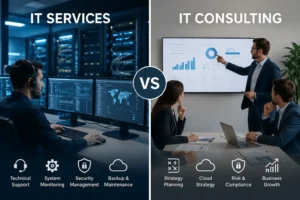
The two can overlap, but their responsibilities and goals are usually different.
Area |
IT Services |
IT Consulting |
Primary focus |
Day-to-day IT management and support |
Technology strategy and planning |
Main goal |
Keep systems reliable, secure, and available |
Improve technology decisions and long-term outcomes |
Typical work |
Monitoring, maintenance, troubleshooting, and support |
Assessments, recommendations, roadmaps, and strategic planning |
Engagement |
Usually ongoing |
Often project-based or strategic |
Typical deliverables |
Technical support, system management, and maintenance |
IT assessments, technology roadmaps, and recommendations |
Time horizon |
Immediate and ongoing needs |
Medium- and long-term technology goals |
Common users |
Employees and operational teams |
Business owners, executives, and IT leadership |
Example |
Managing a company’s network and user devices |
Planning a network modernization project |
Best suited for |
Businesses needing reliable ongoing IT support |
Businesses making significant technology decisions |
IT Services Focus on Execution
IT services are primarily concerned with keeping technology working. This may include managing networks, supporting employees, monitoring systems, maintaining cloud environments, and addressing cybersecurity issues.
For example, if employees regularly experience network problems, an IT services provider can monitor the network, troubleshoot the cause, and provide ongoing maintenance.
IT Consulting Focuses on Strategy
IT consulting focuses more on deciding what technology changes a business should make and how those changes support its goals.
For example, if a company plans to move its applications to the cloud, an IT consultant can assess the current environment, compare options, develop a migration strategy, and identify potential risks before implementation begins.
How IT Services and IT Consulting Complement Each Other
Businesses do not always have to choose one or the other. IT services and IT consulting can work together when a company needs both strategic guidance and ongoing technical support.
A consultant might develop the technology roadmap, while an IT services team implements the recommendations and manages the environment afterward. This creates a connection between long-term planning and day-to-day IT operations.
Which Is Better for Your Business: IT Services or IT Consulting?
Neither option is universally better; the right choice depends on what your business needs from its technology. IT services are generally suited to ongoing support and daily IT management, while IT consulting is more appropriate when you need strategic guidance, technology planning, or help with a major IT decision.
The following situations can help you determine which approach fits your business.
Business Situation |
IT Services |
IT Consulting |
When Both Make Sense |
Frequent technical problems |
Provides ongoing troubleshooting and support |
Reviews underlying technology issues |
Consulting identifies larger problems while services handle ongoing support |
Limited internal IT staff |
Provides day-to-day technical coverage |
Helps determine IT priorities and requirements |
Consulting sets priorities while services handle execution |
Cybersecurity concerns |
Provides monitoring, maintenance, and security support |
Assesses risks and develops security recommendations |
Consulting develops the strategy while services implement and maintain controls |
Cloud migration |
Supports implementation and ongoing management |
Develops the migration strategy and evaluates options |
Consulting plans the migration while services help implement and support it |
Business expansion |
Maintains and scales existing IT systems |
Develops an IT roadmap for future growth |
Consulting plans for expansion while services support the growing environment |
Major technology upgrade |
Implements and maintains approved changes |
Evaluates options and creates an upgrade plan |
Consulting determines the approach while services assist with implementation |
Compliance requirements |
Helps maintain secure and properly managed systems |
Identifies technology risks and compliance requirements |
Consulting develops recommendations while services maintain the environment |
Technology cost concerns |
Optimizes existing IT operations |
Reviews technology investments and recommends improvements |
Consulting evaluates the strategy while services optimize daily operations |
Choose IT Services When You Need Ongoing Support
IT services are a practical fit when your primary concern is keeping technology running reliably. Businesses may benefit from ongoing support when employees regularly need technical assistance, systems require monitoring, or internal teams do not have enough IT resources.
Typical needs include network management, desktop support, cloud management, cybersecurity monitoring, software maintenance, and troubleshooting.
Choose IT Consulting When You Need Strategic Guidance
IT consulting is more appropriate when your business needs help deciding what technology changes to make. This can include planning a cloud migration, replacing outdated infrastructure, improving cybersecurity, preparing for growth, or evaluating technology investments.
In these situations, an IT consultant can assess the current environment and create recommendations based on the company’s goals and resources.
Consider Both When Strategy and Execution Matter
Businesses may need both IT services and IT consulting when they want strategic planning followed by ongoing implementation and management.
For example, a growing company may hire a consultant to assess its infrastructure and create a technology roadmap. An IT services team can then implement the recommended changes, monitor the systems, support employees, and maintain the environment.
This combined approach connects IT planning with day-to-day execution, which can be useful for businesses undergoing significant technology changes.
When Does Your Business Need IT Services?
Your business may need IT services when you require ongoing technical support, system management, monitoring, or maintenance. They are especially useful when technology problems affect productivity or your internal team cannot handle all IT responsibilities.
You may benefit from ongoing IT services when:
- Employees need regular support: IT providers can troubleshoot device, software, account, and connectivity issues.
- Your network needs management: Providers can monitor networks, maintain equipment, and resolve performance or connectivity problems.
- You need continuous cybersecurity: IT services can support security monitoring, updates, endpoint protection, and threat response.
- You rely on cloud systems: Providers can help manage cloud access, configuration, security, backups, and performance.
- Your internal IT team has limited capacity: Outsourced IT services can provide additional technical expertise without requiring a larger in-house team.
Choose IT services when your primary need is keeping your existing technology reliable, secure, and available.
When Does Your Business Need IT Consulting?
Your business may need IT consulting when you are making major technology decisions, planning growth, or need expert guidance to improve your IT environment. Consulting helps you understand what should change, why it matters, and how to prioritize improvements.
You may benefit from IT consulting services when:
- Your business is growing: Plan technology upgrades that can support new employees, locations, or operations.
- You are planning a major IT project: Get guidance for cloud migration, infrastructure upgrades, or technology adoption.
- You have cybersecurity or compliance concerns: Identify risks, security gaps, and compliance requirements before making changes.
- You need to control technology costs: Review existing systems and investments to identify unnecessary spending or better options.
- You need a long-term IT strategy: Create a technology roadmap that connects IT decisions with business goals.
Choose IT consulting when your primary need is deciding how technology should change, improve, or support your business in the future.
Is It Possible to Use IT Services and IT Consulting Together?
Yes, businesses can use IT services and IT consulting together when they need both ongoing technical support and strategic technology guidance. This approach connects long-term planning with day-to-day IT management.
For example, a growing business may work with an IT consultant to:
- Assess its current technology: Identify security risks, outdated systems, and infrastructure gaps.
- Create an IT roadmap: Prioritize technology improvements based on business goals and budget.
- Implement recommended changes: Use ongoing IT services to manage upgrades, cloud systems, networks, and devices.
- Maintain the environment: Monitor systems, provide technical support, and address issues after implementation.
This combined approach can help businesses move from planning to implementation without treating strategy and daily IT operations as separate activities.
IT consulting helps determine what should change, while IT services help implement, manage, and maintain those changes.
What Is the Cost of IT Services and IT Consulting?
The cost of IT services and IT consulting varies based on the size of the business, number of users and devices, service scope, project complexity, and level of expertise required. There isn’t a single cost that works for every company.
Common factors that affect cost include:
- Business size: More users, devices, and locations usually require more support.
- Service scope: Basic technical support may cost less than comprehensive managed IT services.
- Consulting requirements: Assessments, strategy planning, and complex technology projects can require more specialized expertise.
- Security needs: Businesses with higher security or compliance requirements may need additional services.
- Support model: Pricing can differ between hourly, project-based, monthly, and ongoing service agreements.
Before choosing a provider, ask for a clear breakdown of included services, response times, additional charges, and contract terms.
Focus on the value and coverage provided, not just the lowest price, when comparing IT services and consulting providers.
How Do You Choose an IT Services and IT Consulting Company?
Choosing an IT services and IT consulting company starts with understanding your current technology needs, future goals, and the level of support your business requires. Compare providers based on their capabilities rather than services alone.
Consider these factors:
- Services and expertise: Check whether the provider supports your networks, cloud systems, cybersecurity, devices, and other key technologies.
- Consulting capabilities: Look for experience with IT assessments, strategy, infrastructure planning, and technology projects.
- Security practices: Ask how the provider protects systems, manages access, monitors threats, and handles incidents.
- Support model: Review availability, response times, escalation procedures, and ongoing monitoring.
- Scalability: Make sure the provider can support additional users, locations, systems, or technology needs as your business grows.
- Pricing and contracts: Understand what is included, how pricing works, and whether additional project or support fees apply.
- Relevant experience: Consider experience working with businesses similar in size, industry, or technology environment.
The right provider should match your current IT requirements while also having the expertise to support future technology decisions and growth.
Also Read: Cyber Resilience vs Cyber Security: Which One Is More Important for Your Business?
FAQ’s
Q1):- Which is better for small businesses: IT services or IT consulting?
Ans:- Small businesses can benefit from both. IT services help manage daily operations, while IT consulting helps businesses plan smarter technology strategies for future growth.
Q2):- When should a business upgrade from basic IT support to IT consulting?
Ans:- Businesses should consider IT consulting when planning expansion, improving cybersecurity, moving to the cloud, or making major technology changes.
Q3):- What industries benefit most from IT services and IT consulting?
Ans:- Industries such as healthcare, finance, legal, manufacturing, and retail often benefit from professional IT services and consulting solutions because they rely heavily on secure and reliable technology systems.
Q4):- How do IT services improve cybersecurity?
Ans:- IT services improve cybersecurity through system monitoring, software updates, firewall management, threat detection, and proactive security support.
Conclusion
Choosing between IT Services and IT Consulting depends on your business goals and technology needs. IT services help businesses manage daily operations and technical support, while IT consulting focuses on long-term planning, cybersecurity, and business growth strategies.
Many companies use IT services and consulting together to improve efficiency, reduce downtime, and build a more secure IT environment. Combining both solutions helps businesses stay productive and prepared for future technology challenges.
If you are looking for a reliable IT Company in New Jersey, Techproc provides professional IT support, cybersecurity, cloud solutions, and IT consulting services for growing businesses.