


Introduction
The digital world is evolving quickly—and so are cyber security risks for businesses. Today, companies of all sizes face growing threats as cybercriminals use advanced tools to exploit vulnerabilities.
In fact, global cybercrime costs are expected to reach $23 trillion by 2027, highlighting how serious these cyber security risks have become. With the rise of AI, automation, cloud systems, and remote work, the number of common computer security threats is increasing rapidly.
Many businesses still struggle with proper cyber security for business and risk management, making them easy targets for attackers. From data breaches to ransomware, the impact of these computer security risks can be costly and damaging.
In this blog, we’ll explore the top cyber security risks for businesses in 2026 and share practical ways to prevent them.
Key Takeaways
- Cyber security risks for businesses are rising due to AI, cloud, and remote work.
- Phishing, ransomware, and hacking are the most common threats.
- More digital systems mean higher computer security risks.
- Good cyber security for business and risk management helps prevent major losses
Why Cyber Security Risks Are Rising Rapidly in 2026
The increase in cyber security risks for businesses is mainly driven by rapid technological changes. In 2026, attackers are using AI and automation to launch faster and more targeted attacks, making common computer security threats harder to detect.

At the same time, the shift to cloud computing, APIs, and remote work has expanded the attack surface, increasing overall computer security risks. Businesses are also relying more on third-party vendors, which introduces additional vulnerabilities.
On top of that, human error remains a major factor. Without strong cyber security for business and risk management, even a small mistake can lead to serious security incidents.
Top 10 Cyber Security Risks for Businesses in 2026
Understanding the cyber security risks for businesses in 2026 is essential for staying protected. As threats continue to evolve, companies must be aware of the most common risks and how to prevent them.
Below are the top cyber security risks along with practical prevention strategies to help reduce computer security risks and improve overall cyber security for business and risk management.
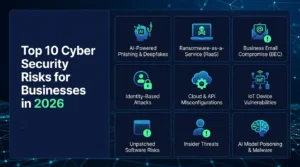
1. AI-Powered Phishing & Deepfake Attacks
Risk:
Cybercriminals now use AI to create realistic emails, voice calls, and deepfake videos to trick employees into sharing sensitive data or approving fake transactions.
A 2024 report by Sapio Research and Deep Instinct found that 75% of security professionals have seen a rise in AI-powered cyber threats, showing how quickly this risk is growing.
Prevention:
- Enforce Multi-Factor Authentication (MFA)
- Train employees to verify unusual requests through secondary channels
- Use AI-powered email security tools
2. Ransomware-as-a-Service (RaaS) & Triple Extortion
Risk:
Ransomware remains one of the most dangerous cyber security risks for business today. Attackers not only encrypt data but also threaten to leak it and pressure customers or partners.
Prevention:
- Maintain secure, immutable backups
- Use endpoint detection and response (EDR) tools
- Develop a strong incident response plan
3. Business Email Compromise (BEC) & Social Engineering
Risk:
Attackers often impersonate executives or vendors to trick employees into sending money or sharing sensitive data—making it one of the most common computer security risks.
According to the FBI IC3, Business Email Compromise (BEC) scams caused nearly $55 billion in losses in 2023, showing how serious these attacks can be for businesses.
Prevention:
- Implement email authentication protocols (DMARC, SPF, DKIM)
- Establish strict payment verification procedures
- Conduct regular employee training
4. Identity-Based Attacks & Credential Theft
Risk:
Stolen passwords and login credentials are a major entry point for attackers. Once inside, hackers can move across systems without being noticed, making identity-based attacks a serious risk in cyber security.
Prevention:
- Adopt a Zero Trust security approach (never trust, always verify)
- Use phishing-resistant Multi-Factor Authentication
- Monitor login patterns and detect unusual activity
5. Cloud & API Misconfigurations
Risk:
As businesses shift to the cloud, misconfigured storage, exposed APIs, and weak access controls have become major sources of cyber security risks for businesses. Even a small mistake can expose sensitive data to the public.
Prevention:
- Use Cloud Security Posture Management (CSPM) tools
- Conduct regular cloud security audits
- Implement strict role-based access controls
6. Supply Chain & Third-Party Attacks
Risk:
Cybercriminals often target vendors or partners with weaker security to break into larger organizations. With businesses depending more on third-party services, this has become one of the top cyber security risks.
A well-known example is the 2020 SolarWinds attack, where hackers compromised software updates from a trusted vendor and gained access to multiple high-profile organizations.
Prevention:
- Perform regular vendor risk assessments
- Limit third-party access to critical systems
- Use Software Bill of Materials (SBOM) for better visibility
7. IoT & Edge Device Vulnerabilities
Risk:
The growing use of IoT devices—such as smart office equipment and connected systems—has introduced new computer security risks. Many of these devices lack proper security, making them easy targets for attackers.
Prevention:
- Segment IoT devices on separate networks
- Regularly update firmware and software
- Disable unnecessary features and access points
8. Unpatched Software & Legacy Systems
Risk:
Outdated software and legacy systems often contain known vulnerabilities that attackers can easily exploit. This makes them a major contributor to ongoing cyber security risks.
Prevention:
- Enable automatic software updates
- Replace outdated systems with modern solutions
- Implement a regular patch management process
9. Insider Threats & Data Leakage
Risk:
Not all threats come from outside the organization. Employees, contractors, or partners can accidentally—or intentionally—leak sensitive data. This makes insider threats a critical part of cyber security and risk management.
Prevention:
- Use Data Loss Prevention (DLP) tools
- Apply least-privilege access controls
- Monitor user behavior and access patterns
10. AI Model Poisoning & Advanced Malware
Risk:
With the rise of AI, attackers are now targeting AI systems themselves. They can manipulate data used to train models or use automation to launch more advanced malware attacks, increasing overall cyber security risks for businesses.
Prevention:
- Secure AI training datasets and pipelines
- Use runtime application self-protection (RASP) tools
- Continuously monitor systems for unusual behavior
How Cyber Security Impacts Business Growth and Reputation
Ignoring cyber security risks for businesses can have serious consequences beyond just technical issues. A single cyberattack can lead to major financial losses due to downtime, data recovery, or ransom payments.
There are also legal and compliance risks. Businesses that fail to protect sensitive data may face penalties, lawsuits, and regulatory issues, increasing overall cyber security and risk challenges.
Most importantly, cyber incidents damage customer trust. When clients feel their data isn’t secure, they’re less likely to continue doing business with you. This directly affects growth, reputation, and long-term success.
That’s why managing computer security risks and investing in proper cyber security for business and risk management is essential for any organization in 2026.
Why Businesses Should Invest in Cyber Security Services in 2026
As cyber security risks for businesses continue to grow, investing in the right cybersecurity services has become essential. It not only protects your systems but also supports long-term business stability and growth.
1. Proactive Protection Over Reactive Approach
With rising threats, businesses must focus on prevention rather than reaction. Proactive monitoring helps reduce exposure to common computer security threats.
2. Lower Costs and Business Risks
Cyberattacks can lead to serious financial losses. Investing in cybersecurity minimizes damages caused by computer security risks and reduces long-term expenses.
3. Stronger Cyber Security and Risk Management
Professional services improve cyber security for business and risk management through continuous monitoring and regular security checks.
4. Access to Expertise and Advanced Tools
Businesses benefit from expert support and advanced tools to handle evolving cyber security and risk challenges.
5. Improved Trust and Competitive Advantage
Strong security builds customer confidence and helps reduce cyber security risks for businesses, giving your business a competitive edge.
Also Read: Types of Cloud Computing Services Every Business Should Know in 2026
FAQs
Q1):- What is the biggest cyber security risk in 2026?
Ans:- Ransomware and AI-powered phishing attacks are among the biggest cyber security risks for businesses due to their increasing sophistication and impact.
Q2):- How can small businesses protect themselves from cyber attacks?
Ans:- Small businesses can reduce cyber security risks by using Multi-Factor Authentication (MFA), training employees, updating systems regularly, and investing in cybersecurity services.
Q3):- How often should a business conduct a security audit?
Ans:- To effectively manage cyber security and risk, businesses should conduct security audits at least once or twice a year, along with continuous monitoring.
Q4):- What are the benefits of managed cyber security services?
Ans:- Managed services help reduce computer security risks by offering 24/7 monitoring, expert support, and proactive threat detection.